An Exploration of Bagoong
July 27, 2026
As an island archipelago of approximately 7,641 islands, one of the ways that indigenous Filipinos preserved surplus seafood was through the process of making bagoong, a fermented paste most often made from shrimp or fish but sometimes also from oysters, mussels, and clams that have been mashed with salt. The seafood slowly breaks down and ferments and becomes a salty, pungent, deeply oceanic paste. Bagoong can be found on every island of the Philippines and is commonly used to flavor stews like kare-kare or pinakbet.
This humble paste has so much flavor impact, it is often eaten on its own as an accompaniment to plain cooked rice. “When a poor man has nothing to go with his rice, he may just have bagoong with it,” Doreen F. Fernandez writes in Tikim: Essays on Philippine Food and Culture about this beloved condiment and the many ways it shows up in the various regions of the Philippines. In the Visayas, where most of my family has roots, it shows up as “dark and pasty,” while Fernandez describes bagoong from the region of Balayan as “smooth liquid into which every single spine and bone has been melted by time and salt.”
The practice and tradition of making bagoong has been passed down through centuries from pre-colonial Philippines to the present day and now is an ingredient that is massed produced and sold wherever there is a Filipino community. Not only is it an intrinsic ingredient of ancient Filipino culinary practices, but also carries the spirit of colonial rebellion.
Bagoong is fragrant and the seafood must first go through a process of decomposition then fermentation before the beauty and bold complexity of the ingredient can be achieved. The aromas of that process were jarring to the nose of foreign invaders. Their disdain for the smell was mentioned in texts written by Spanish colonizer, Antonio de Morga, author of Sucesos de las Islas Filipinas. Spanish colonizers were the first to use diminishment tactics on Filipino cuisine, calling our food smelly, as a form of shaming indigenous culinary practices to center and uplift their own foodways and culture. There are rumors that they even tried to outlaw the ingredient but I could not find any research supporting that lore. It is heavily restricted to transport bagoong in your carry-on luggage though.
For me personally, bagoong represents change, longing and loss, even before I ever understood what any of those feelings actually were. As a small child, I lived in the Philippines. My first real memories of any recollection are of my life based there. Even though I lived on an American military base, the community that surrounded me was mostly Filipino. My mom was raised in the next town, which meant I had an expansive family that lived nearby. We had a gardener, who would shimmy up the coconut tree with his machete and cut down coconuts, warning us to watch our head from above. He would shimmy back down and whack the coconut on the top and crack it open on the front lawn for me to slurp down. Monkeys lined the roadways and snakes were a constant pest. Thousands of giant bats would blanket the sky every dusk and I would lay on my lawn with my hands behind my head and watch them dance above me.
My days were punctuated with my great-grandmother and I taking the bus down the hill for our regular trips to the Olongapo City Public Market to run errands in town. It seemed my great-grandmother knew everybody as we would stop and chat with folks along the way. There were always snacks – pandesal, puto, suman and fruits. My very favorite snack of them all was Mango Bagoong: sour mango served with a side of the deepest briney schmear of bagoong.

At some point, my parents began to argue and what started as occasional skirmishes, intensified into constant and full blown rows. I cannot remember if anyone ever explained to me what was happening, but my parents were divorcing. My idyllic jungle upbringing came to an abrupt end.
Next thing I know, I’m on a 747 to Los Angeles then San Diego, ripped away from my home, from my father, my aunties, uncles, cousins and friends, ripped away from my constant companion, my great-grandmother. It is now just me and my mother and a new life with a new group of people who were strangers but were calling themselves my family, a new culture, a new language, a new cuisine, a whole new reality.
When we arrived in Oceanside, where these family of strangers lived, the table looked different. I was surrounded by Filipino faces but salt and pepper took the place of where the bottle of patis and the jar of bagoong used to sit. I remember asking for mango bagoong and realizing that I may never eat it again. I remember reaching out for those condiments like a phantom reflex. Now that reflex feels like a metaphor for everything I was reaching out for, my dad, my lola, my family, my old life, the monkeys, the bats. Nothing would ever feel that way again. The things I held so dear were now subject to ridicule, which was deeply confusing for me, and I would eventually come to understand the jokes as veiled racism. The ingredients that were my normal were slowly erased from my mom’s new American pantry.
I didn’t eat a proper Mango Bagoong for 35 years. In 2019, I went back to the Philippines for the first time since I was ripped away. I was 42 years old. It was one of the top foods on my list to seek out just to purely give that little girl a taste of one of the warmer periods of my childhood. It was the end of the season but there was one magic mango vendor at Rizal Park in Manila, with a tray of sour mangos and a canister full of bubbling bagoong. I wept as I brought the salty-sour mango to my tastebuds and gave the moment my full presence.
In honor of this ingredient, I wanted to showcase that bagoong is just as integral to building flavor in dishes in comparison to universally accepted ingredients like anchovies and can even be used interchangeably. American-published recipes exalt anchovies (I get it, I love them too!) but I also want to show the world that there is more to bagoong than kare-kare and pinakbet. I used to purchase jars, use them for a couple recipes and then never touch the jar again. I’ve deepened my relationship with this ingredient and have become more intentional with utilizing it in my regular cooking. I often use it to deepen the flavor pasta sauces, as a flavor building component in a variety of soups and stews, and use it to enliven roasted vegetables.
Three Bagoong Recipes
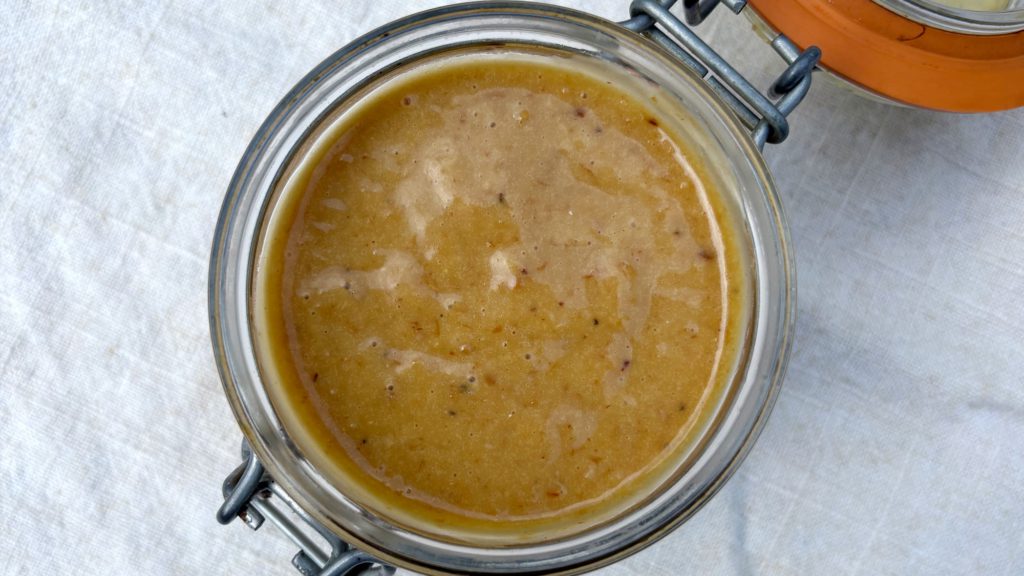
Bagoong Caesar Dressing
In this Bagoong Caesar Dressing, I use bagoong in place of anchovies in my recipe. Not only do I use it for my salads, I also drizzle it on roasted vegetables, brush it on proteins. We have the best results with using a hand mixer.
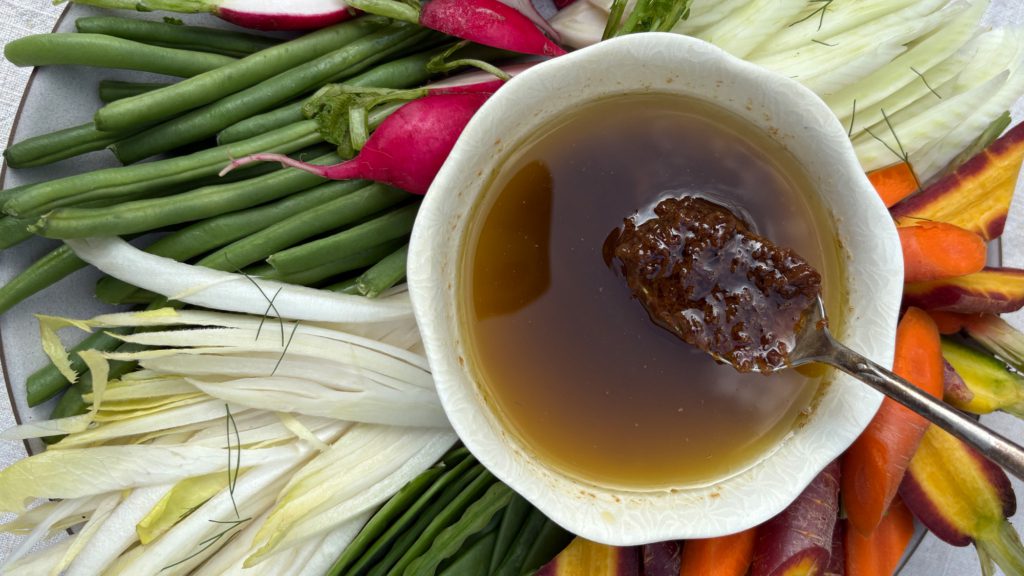
Bagoong Roasted Zucchini Tart
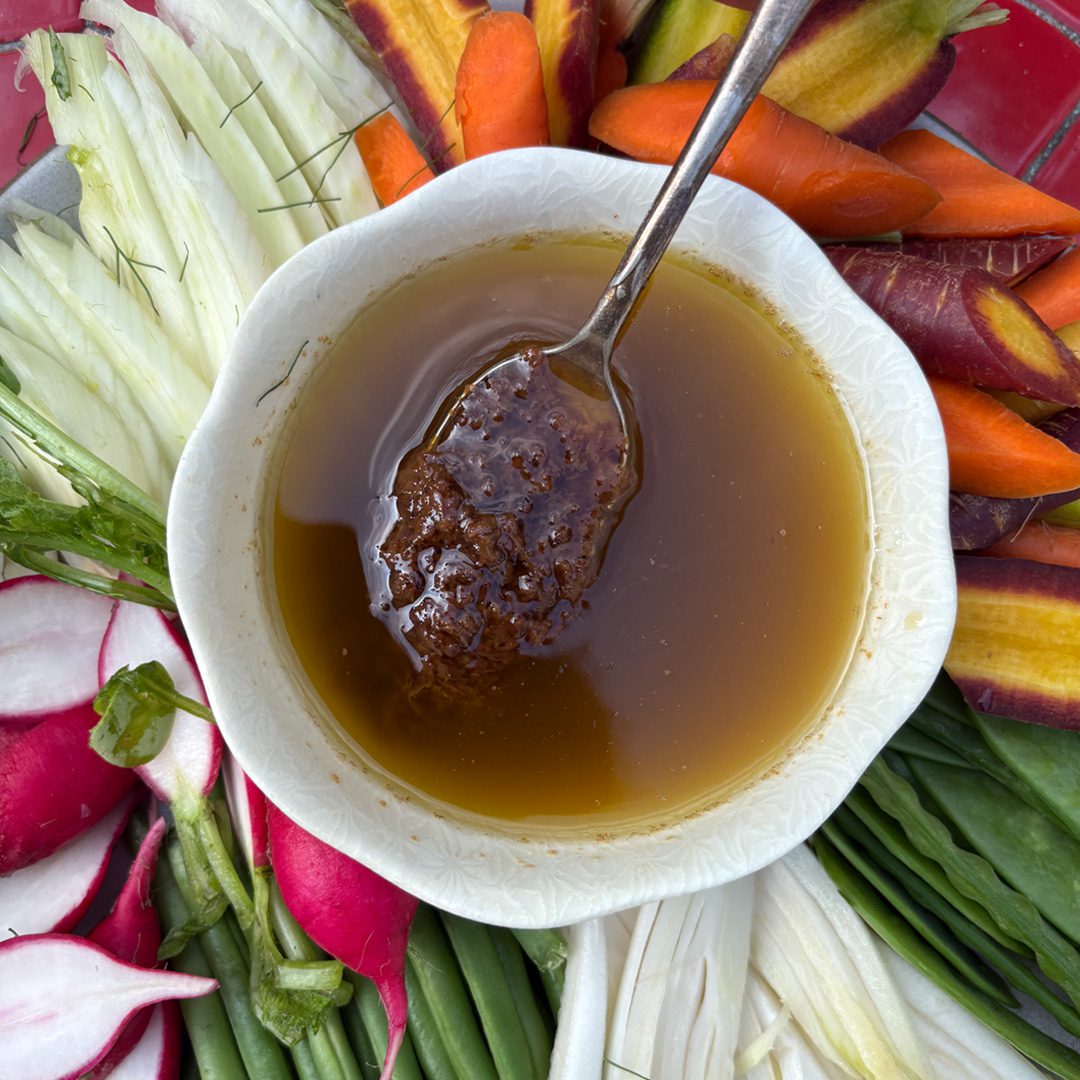
I give crudite a Filipino twist in my Bagoong Bagna Cauda recipe, where I combine shrimp paste, garlic and olive oil to make a warm dipping sauce. The mixture can also be used as a marinade or toss the flavored oil on vegetables to roast or grill.
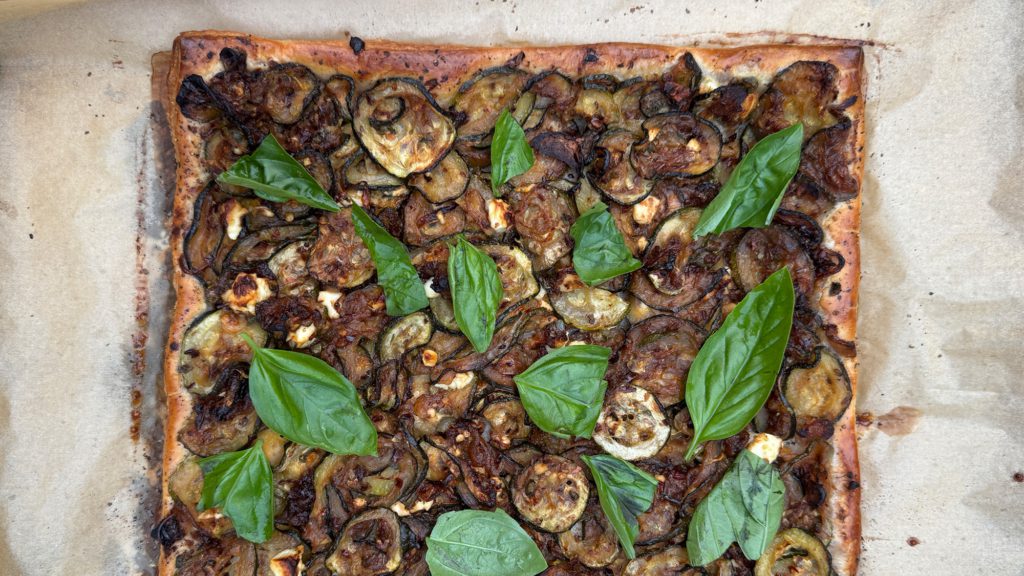
Bagoong Roasted Zucchini Tart
I use bagoong to deepen the flavor of zucchini in the Ottolenghi-inspired, Bagoong Roasted Zucchini Tart. I have the pleasure of testing Ottolenghi’s monthly New York Times column and in his July recipe, he roasts zucchini with anchovies, garlic and aromatics then completes the dish with roasting chicken legs on top. It’s delicious and I recommend you make it and every single on of his recipes on the New York Times and buy all his cookbooks. He’s one of my favorite chefs and recipe developers.
In my riff off his recipe, I swap the anchovies for bagoong, par roast the zucchini and aromatics then place it on top of store-bought puff pastry to make a delicious summery-tart for your patio spreads. He’s one of my favorite chefs and recipe developers. In my riif off his recipe, I swap the anchovies for bagoong, par roast the zucchini and aromatics then place it on top of store-bought puff pastry to make a delicious summery-tart for your patio spreads.